ComparisonUpdated October 2026
Vermillion Online vs Elite Dangerous
Quick answer
Elite Dangerous is Frontier's flight-focused space game set in a 1:1 Milky Way, where you buy and outfit fixed ships, PvP is optional through Solo and Private Group modes, and losses come back through a rebuy. Vermillion Online is a small, free playtest where you design ships block by block, everyone shares one server, and destroyed ships drop full loot. Pick Elite for flight and exploration; try Vermillion if you want your own design and real stakes.
Elite Dangerous is the space game for people who love flying. Vermillion shares the love of Newtonian flight and flight assist off, then goes somewhere Elite doesn't: you build the ship, and PvP with full loot is the whole point.
Facts as of October 2026Elite Dangerous is a game by Frontier Developments
The short answer
Elite Dangerous gives you a 1:1 model of the Milky Way, with hundreds of billions of star systems, and some of the best ship handling in any game. You buy ships at shipyards, outfit them with modules and improve them through Engineers. You choose how much other players matter: Open play, Private Groups, or Solo. When you lose a ship you pay a rebuy cost to get it back. It's a buy-once game on PC, with the Odyssey expansion adding on-foot play, and since system colonisation (beta in February 2025, full release in November 2025) commanders can claim empty systems and build stations there.
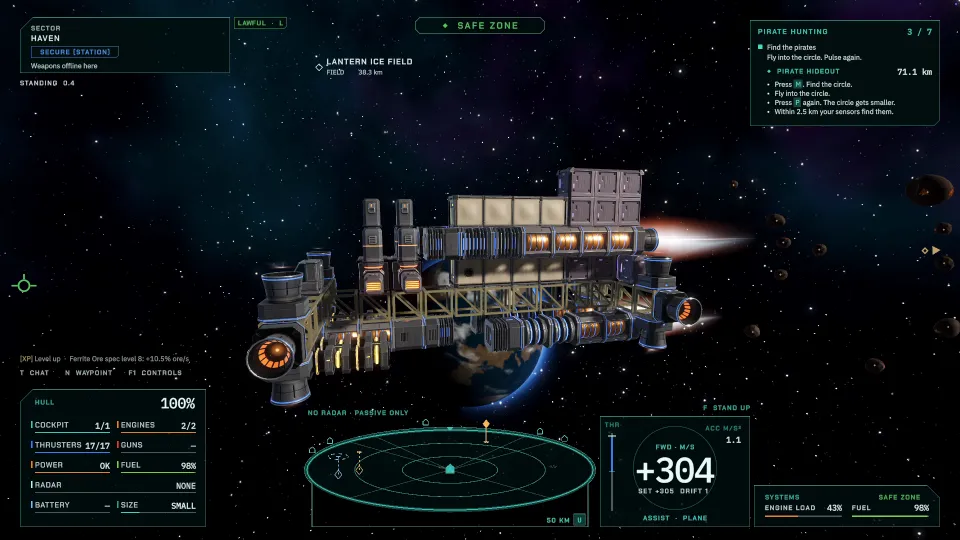
Vermillion Online is a much smaller game with a different goal. One zone of 19 sectors, a player-run market, and full-loot PvP in risk-graded space. Ships are designed in 1 m blocks, their engines and guns are physical assemblies, and how they fly comes from how you built them. It's a free playtest on Mac and Windows with one EU server and possible wipes.
| Vermillion Online | Elite Dangerous | |
|---|---|---|
| Stage | Free playtest, progress may be wiped | Released 2014, still updated |
| Price | Free download; no price set for later | Buy once ($19.99 list price, Horizons included; Odyssey sold separately); new ships come to ARX premium currency first |
| Platforms | macOS and Windows | Windows PC; consoles stayed on the older Legacy galaxy after 2022; Mac support ended in 2018 |
| World | One zone: 19 sectors over about 200 km | The Milky Way at 1:1 scale |
| Other players | One shared server, always | Open, Private Group or Solo; you choose per session |
| Ships | Designed block by block, or stock designs; fabricated from refined materials | Fixed hulls bought at shipyards, outfitted with modules, upgraded by Engineers |
| Flight | Newtonian 6-axis; thrust from where you placed thrusters; flight assist toggle | Flight assist on or off, tuned per ship |
| On ship loss | Half the cargo destroyed, rest in the wreck; hulk salvageable; free Rookie Ship | Pay the rebuy to get the ship back; cargo is lost |
| Economy | Player order books per station; no global inventory | NPC markets driven by the background simulation |
| On foot | Walk your ship with magnet boots, EVA, boarding, pistols and rifles | Odyssey: planets and settlements on foot |
| Player building | Ships, block by block; no player stations | No ship design; system colonisation lets players build stations |
Elite details from Frontier's official site and patch notes. Corrections welcome on Discord.
Flying: where the two games meet
If you fly Elite with flight assist off, you'll feel at home. Vermillion uses Newtonian flight on six axes with flight assist you can toggle. There's no speed cap. Ships keep accelerating as long as there's thrust, and typical designs top out around 150 to 300 m/s depending on thrust, size and mass.
The big difference is where the handling comes from. In Elite, Frontier tuned every hull, and Engineers let you push the numbers. In Vermillion, the handling falls out of your design. Thrust comes from where you placed thrusters. Put too little thrust forward and the ship is slow to accelerate. Put the mass off-centre and it fights you. A badly built ship flies badly, and that's on purpose.
Outfitting vs. building
Elite's outfitting is about choosing modules for slots of fixed sizes, then grinding Engineers to improve them. Vermillion's equivalent is the Ship Designer. You place 1 m blocks: 68 armour shapes in 5 materials, plus about 140 functional and structural parts. Engines, thrusters, cannons, radar and mining lasers are assemblies made of parts. A thruster is a nozzle plus amplifiers plus coolers; a cannon is a firing piece plus barrels, clips, autoloaders, gauge increasers and recoil absorbers. Bigger assemblies give more performance and cost mass, heat and space.
You can test-fly any design straight from the designer before spending a credit, which is a lot cheaper than buying a ship to find out you hate it.
PvP: optional vs. built in
Elite lets you avoid other players completely with Solo or a Private Group, and many commanders play that way. Vermillion doesn't have that switch. Everyone is in the same space. What you get instead is a choice of risk by location:
- Secure: no damage.
- High security: attacks land, but the attacker turns Criminal and invisible police destroy them 20 seconds later.
- Low security: no police; criminals are fair game; station guns.
- Lawless: no rules.
The best ore is further out. Titanite only spawns in Low security and Iridium only in Lawless. You can earn a living in safer space; the jackpots are where other players can find you.
Losing a ship
In Elite you pay the rebuy and get the same ship back. In Vermillion there's no rebuy. A destroyed ship loses half its cargo, the rest spills into the wreck for anyone, and other players can salvage the hulk. A dead character drops a body bag with everything carried, half destroyed. You always get a free Rookie Ship, so you can start again, but the ship you lost is gone. That loss is what keeps miners mining and builders building.
Exploration, Vermillion style
Elite's exploration is a galaxy. Vermillion's is smaller and more hostile. You only see what your sensors detect. Pulse radar reveals hidden ore fields and pirate sites as signatures you narrow down on the map, but every pilot in range hears the ping as a bearing. A server director spawns ore fields and pirate sites around online players; fields deplete and respawn elsewhere, and jackpot fields are announced by sector to the whole server.
What Elite does better
- A whole galaxy to explore, with real stars and planets you can land on.
- Years of polish on flight, sound and cockpit feel.
- Solo and Private Group modes for people who don't want PvP.
- A long list of careers, from exploration to trading to combat, all deep.
- System colonisation: players can claim nearby systems and build starports, which Vermillion doesn't have.
Vermillion has one zone, no planetary landing, one server, simpler art, and a handful of pilots per session so far.
Common questions
Does Vermillion Online have a Solo mode like Elite?
No. Everyone shares one server. You choose your risk by location: Secure space has no damage, and Lawless space has no rules.
Does Vermillion have flight assist off?
Yes. Flight is Newtonian on six axes and flight assist can be switched off.
Is there a rebuy in Vermillion Online?
No. A destroyed ship is lost, half its cargo is destroyed and the rest spills into the wreck. You always get a free Rookie Ship to start again.
Can you design ships in Vermillion?
Yes. You build ships in 1 m blocks in the Ship Designer, and how a ship flies comes from where you placed its thrusters and mass.
Does Vermillion Online run on Mac?
Yes, on macOS and Windows. Elite Dangerous ended Mac support in 2018.
Who should play which
Play Elite Dangerous if you want to fly through a real-scale galaxy on your own terms, with or without other people. Try Vermillion Online if you want your ship to be your own design, and want the risk of losing it to other players to be part of every trip. It's free and early, and it runs on Mac, which Elite no longer does.
More comparisons: Vermillion vs Star Citizen, Vermillion vs EVE Online, all comparisons.
Fly something you designed
If you've ever stared at an Anaconda and wished you could move the thrusters, give the Vermillion playtest a try. It's free, and the first ship is on us.
Playtest: progress may be wiped. One EU server. The builds are unsigned, so macOS and Windows warn you once on first launch.